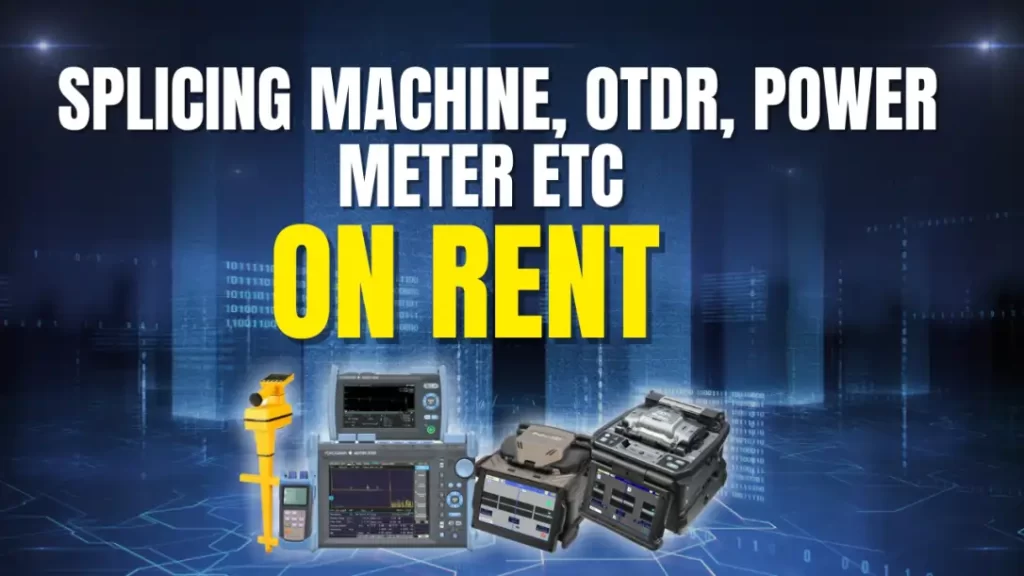
In today’s ultra-connected world, data centres are the backbone of enterprise operations—from cloud computing and streaming to real-time analytics and high-speed connectivity. To support such intense demands, fibre-optic networks inside data centres must deliver extremely low latency, low loss, and high reliability. That’s why selecting the right splicing machine is critical.
- Why a top-quality splicing machine matters in data centre environments
- Key features to look for
- How Keith Electronics (India) can support your purchase and service needs
- A recommended checklist & best-practice workflow
Whether you are deploying new cabling, upgrading existing fibre infrastructure, or maintaining hyperscale data centre environments, this guide will help you choose the right machine and partner for the job.
Why a High-Quality Splicing Machine Matters in Data Centres
1. Low Loss & High Reliability
When you splice optical fibres in data centres, every fraction of a decibel in insertion loss adds up. According to fibre-optics industry guidance:
“Fusion splicing offers the lowest insertion loss (0.1–0.3 dB), delivering the highest reliability and performance for critical links in fibre-optic data centre environments.”
Using a machine that does core-alignment splicing (rather than simple fixed-V-groove) can further reduce loss and back-reflection — essential for high-speed, high-density networks.
2. Speed and Efficiency for High-Density Deployments
Data centre environments often require hundreds or thousands of splices in tight time-frames. As one industry guide notes:
“High-density fibre installations… in data centres require splicers capable of handling large-scale installations while maintaining minimal signal loss.”
Speed-aligned splicers help reduce labor time, minimize downtime, and ultimately lower cost per splice.
3. Data-centre Specific Requirements
Data centre fibre splicing differs from typical field telecom splicing in several ways:
- Higher fibre counts (multi-ribbon cables, high-density patch panels)
- Stringent performance and reliability requirements
- Indoor/controlled environment but still demands durability and repeatability
Thus selecting a machine tailored to these demands (and a supplier who understands them) is key.
Why Choose Keith Electronics for Your Splicing Machine Needs
Keith Electronics Pvt. Ltd. (based in India) is a reputed distributor and service provider for high-end optical fibre splicing machines, particularly suited for telecom, FTTH and data centre applications. Here are some reasons to consider them:
- Established in 1980, with more than 40 years of experience in advanced electronics and optics. Keith Electronics
- They are official distributors of leading brands such as Fujikura (which make premium fusion splicers) and provide full service / after-sales support. Keith Electronics
- Their product catalogue includes splicing machines explicitly suited for data-centre / LAN / FTTx environments (for example, Fujikura 48S+ described for data centre/LAN). Keith Electronics
- They have a pan-India presence with branches in multiple cities and support infrastructure for installation, training & AMC. Keith Electronics
For data centre operators in India (or nearby regions), Keith Electronics offers a trusted pathway to procure not just the equipment but also support and service locally.
What to Look For: Key Features When Choosing a Splicing Machine for Data Centres
Below is a checklist of features you should prioritise when selecting a splicer for data-centre usage. Use this to compare models and suppliers (like Keith Electronics).
| Feature | Why It Matters for Data Centres |
|---|---|
| Core-to-core alignment | Minimises splice loss especially in single-mode fibres and higher-density environments. Data centre links demand lowest possible attenuation. |
| Fast splice & heat times (e.g., <10 s splice time, <20 s heat) | Improves productivity when many splices must be made. |
| Low splice loss / high return loss | Ensures longevity and performance of links—specs like ≤0.03–0.05 dB for homogeneous fibres are found in standards. tec.gov.in |
| Data storage / traceability | For data-centre audits, quality assurance—machines that store splice results, loss estimates, etc. |
| Mass-fibre/ribbon capability | Data centres may deploy multi-fibre ribbons; the ability to splice multiple fibres or ribbon splicing may help. |
| Battery/portability & ruggedness | Though indoors, machines may be moved across racks/rooms; robustness counts. |
| Service/parts support in region | Critical for uptime – ensure spare electrodes, calibration, etc. |
| Brand & distributor reputation | Choose machines with proven performance in similar environments; distributor must support training, after-sales. Keith Electronics is such a partner in India. |
How Keith Electronics Supports Data-Centre Splicing Needs
Here’s how you can leverage Keith Electronics for your data-centre fibre splicing deployments:
- Consultation & selection: Keith’s team can help determine the right splicer model based on your application (e.g., single-mode high-density, ribbon splicing, etc.). Their product listings include models like Fujikura 33S, 43S, 48S+, 66S+ and 88S+. Keith Electronics+1
- Procurement & logistics: Being pan-India, they can deliver to your site and support multiple branches if you have a multi-site data centre. Keith Electronics
- Training & support: They offer after-sales care, service camps, training on operation and maintenance of machines. Keith Electronics
- Maintenance & spares: In data centres you can’t afford downtime; a local distributor helps in fast servicing and spare parts.
- Future-proofing: With new fibre types (bend-insensitive, large area), newer splicing machines are required; Keith highlights machine models built for modern demands (e.g., data centre/LAN). Keith Electronics+1
Example Workflow: Deploying a Splicing Machine in a Data Centre
Here’s a simplified best-practice workflow you can adopt when deploying a new splicing machine via Keith Electronics:
- Define requirements: Number of splices, type of fibre (SM/MM), ribbon vs single, loss budget, turnaround time.
- Select machine: With Keith’s help, choose a model (e.g., Fujikura 48S+ for LAN/data centre).
- Procure & install: Receive the machine, do acceptance test (e.g., splice sample fibres, measure loss).
- Train technicians: Ensure proper cleaving, fibre cleaning, alignment — operator skill makes a difference.
- Deploy operations: Use the machine for splicing operations, record data/results, ensure documentation.
- Maintenance plan: Schedule electrode replacement, calibration, keep spare consumables, leverage Keith’s service.
- Quality assurance: Use OTDR/power-meter tests post-splice; verify loss and reflectance meet specs.